三家 AI 供应商在两周内调整了使用限制:如果你为 AI 付费,这意味着什么
Three AI vendors restructured usage limits in two weeks: what it means if you pay for AI
我们发现了什么
2026年8月25日至9月10日期间,Anthropic、OpenAI 和 GitHub Copilot 各自更改了……
- 来源:DEV Community(发现于 2026-11-09)
- 证据等级:C · 存在定价或订阅线索;有收费设计不等于已有收入。
- 商业模式:待核验
- 主题:独立产品
- 初筛评分:14.2/100 · 收录 1 次
证据,比故事更重要。
规则清洗与初筛,未经人工商业核验。原文语境、实际客户和付费情况仍需自行验证。
引用与数字披露
来源类型(原作者自述/第三方测算/媒体转引)需采集端标注,本版尚未落字段。
- 作者
- 未标注
- 抓取日期
- 来源类型
- 未标注
- 币种
- 未标注
- 口径
- 未标注
- 披露主体
- 未标注
- 披露日期
- 未标注
上下文核对:来源原文含限定词预测,中文摘要未逐字保留 —— 引用或跨期比较前请回原文核对,别把估算读成已实现。
中文辅助译文(全文)
2026年8月25日至9月10日期间,Anthropic、OpenAI 和 GitHub Copilot 各自更改了其付费 AI 套餐的用量限额。没有一份公告说“我们要削减你的访问权限”,有些甚至把这一变化说成是增长。但数学讲述了另一个故事
当三家主要 AI 厂商在同样的两周内重塑各自的用量限额时,就很难再把其中任何一家视为孤立的决策。一种模式正在显现。
这并非时间上的巧合。在经历了大约十八个月的促销慷慨期后,AI 订阅市场正在寻找其永久价格底线。促销在竞争最激烈时留住了用户。现在它们正在到期、稳定下来或被重新校准,因为前沿模型的计算成本要求更谨慎地配给。订阅者的访问权限要么维持,要么不维持,而这些调整的传达方式往往让人难以分辨究竟是哪一种。
以下是三家厂商各自实际发生的变化、为什么重要,以及如果你的工作依赖于每月付费的 AI 工具,应该追踪什么。
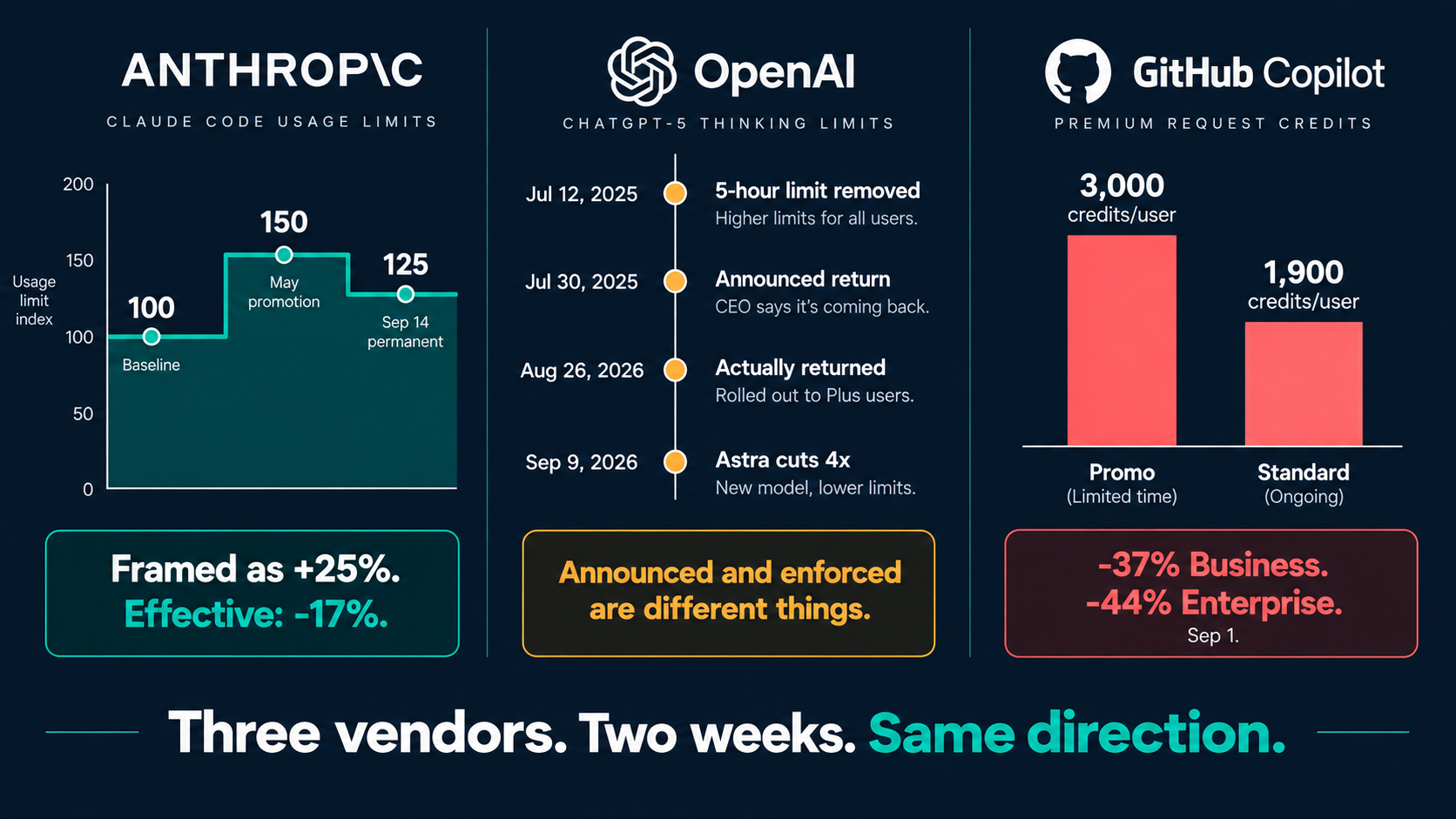 图注:三家 AI 厂商付费套餐用量限额调整概览(英文图表)。
Anthropic 改了什么:一次“25% 的增长”,实际是 17% 的削减
2026年8月29日,Anthropic 宣布从9月14日起,将 Claude Code 的标准每周用量限额永久提高25%。公告称其为增长,这一描述在技术上正确。
背景才是关键。自2026年5月13日起,Claude Code 订阅者一直在使用比促销前基线高50%的每周限额。这一提升通过五次连续延期得以延长,每次延期都换来一个新的结束日期,却没有承诺永久水平。订阅者在更高上限下度过了十五周。许多团队围绕它构建了工作流,有些甚至据此配置了人员。
当9月14日到来时,每周限额变为原始促销前基线的125%。以那个旧数字衡量,是+25%。以5月以来生效的水平衡量,是-17%。Anthropic 自己的沟通确认了这两个数字:“我们将 Claude Code 的标准每周限额永久提高25%”,以及在后一次说明中,“相对于公告当天生效的水平,这相当于 Claude Code 每周限额减少了17%”。
两种说法在算术上都精确。分歧不在于数字,而在于哪一个数字位于分母。对厂商而言,参照点是六个月前的促销前基线。对订阅者而言,参照点是他们十五周来一直触及的上限。数学相同,形容词相反。
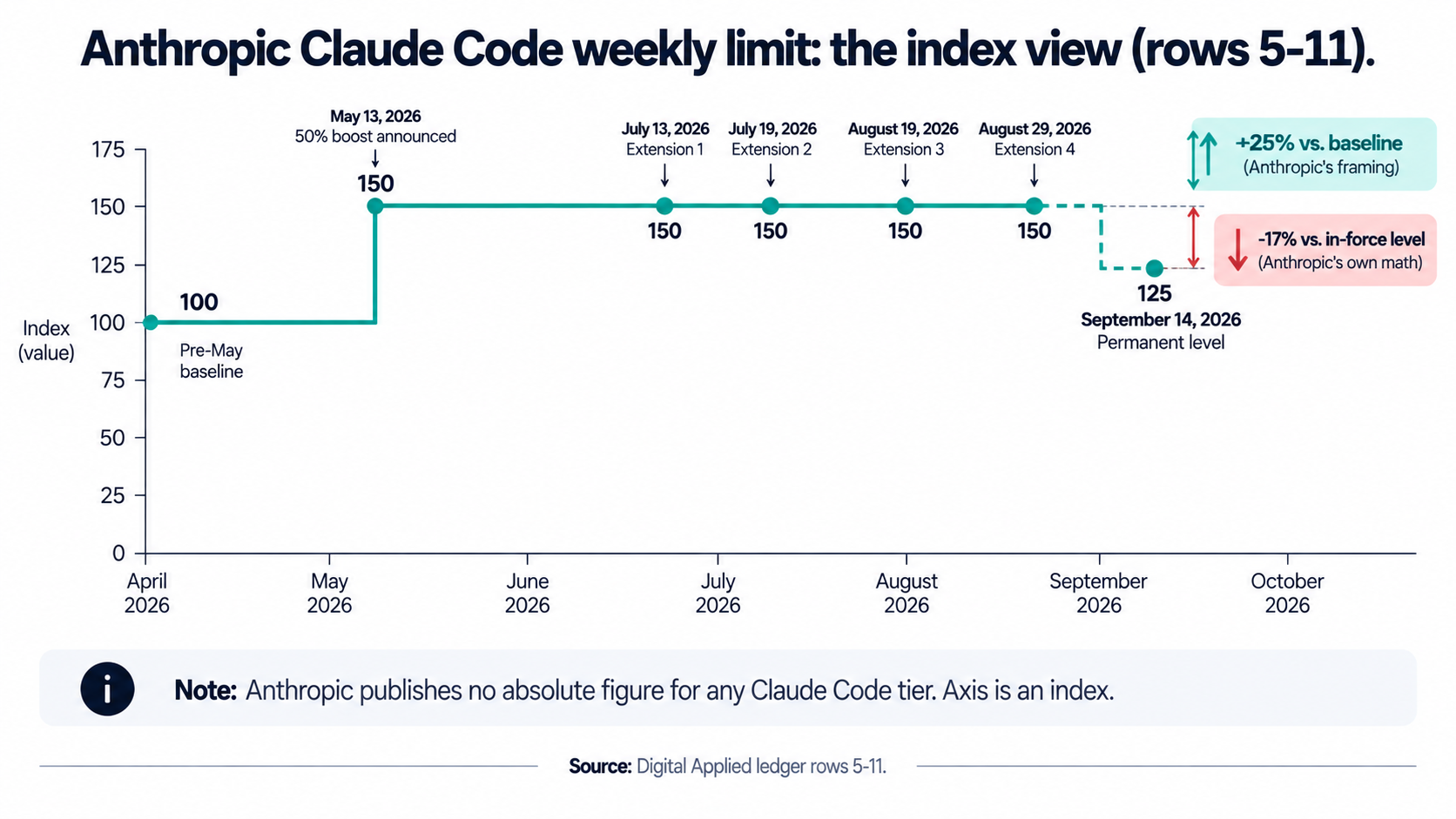 图注:Claude Code 每周限额从促销前基线100、促销期150到9月14日起永久125的变化示意(英文图表)。
实际中的指数: Anthropic 没有公布任何付费层级上任何 Claude Code 每周限额的绝对数字:既没有基线,也没有提升后的水平,也没有9月14日起的永久水平。唯一可验证的数字是相对值:100(基线)、150(促销)和125(9月14日起永久)。如果你想知道你的套餐真正允许多少 token、提示或请求,Anthropic 的文档里没有这个数字。
OpenAI 改了什么:那个不断消失的5小时限额
OpenAI 的两周窗口包含两项独立变化。它们值得分开来看,因为每一项都以不同方式影响不同的订阅者群体。
8月25日,OpenAI 的 Codex 和 ChatGPT 负责人 Tibo Sottiaux 宣布,滚动五小时用量限额将于次日对 Plus 账户恢复。他的原话是:“明天我们将为 ChatGPT Work 和 Codex 的 Plus 账户恢复5小时限额。我之前提到过这件事,但后来推迟了。”这句话带着一个不动声色的承认。该限额最初被宣布于7月30日恢复,随后又在8月25日再次宣布,而 Plus 订阅者在中间四周里一直没有五小时上限。
其背后的顺序有记录可查。7月12日,OpenAI 在 GPT-5.6 Sol 发布周期间暂时完全取消了滚动五小时限额。7月29日,它宣布该限额将于7月30日恢复,但当天并未对 Plus 订阅者恢复。8月25日的公告是对同一恢复动作的第二次尝试。总计,该限额消失了超过六周。这一缺失部分是无意的,部分是推迟的,并且通过至少三篇独立帖子传达,其中没有一篇说“我们上次推迟了这件事”。
第二个 OpenAI 事件更为尖锐。9月9日,OpenAI 将重度用户的 GPT-6 Astra 用量限额最多削减至四分之一,并于9月10日确认,新的200美元 Pro 套餐订阅正在暂停,以保护现有订阅者的服务质量。OpenAI 还在测试付费重置选项:在 Plus 套餐上花5至8美元即可立即补充已触及的限额,在 Pro 上则升至50至80美元。自6月以来,OpenAI 一直提供免费的存储重置。同样的缓解现在带上了价格标签。
GitHub Copilot 改了什么:促销窗口关闭
三者之中,GitHub Copilot 9月1日的变化披露得最清楚。当 Copilot Business 和 Enterprise 客户于2026年6月1日转向基于用量的计费时,他们获得了促销性包含额度:Business 每用户每月3,000,Enterprise 为7,000。GitHub 自己的计费文档给出的促销窗口是6月1日至9月1日。
9月1日,促销额度结束,标准包含额度接替:Business 每用户每月1,900额度(较促销水平减少37%),Enterprise 为3,900(减少44%)。一个十人 Business 团队此前每月使用30,000额度,现在9月起的下限是19,000。如果该团队在促销期内没有调整其工作流用量,现在就会面临缺口。
GitHub 在此处的透明度值得明确肯定。结束日期从一开始就在计费文档中,标准额度是承诺的基线,促销水平始终被标记为促销。9月1日的削减是提前披露并在文档中明确说明的,GitHub 的公告框架与有效方向一致。同一窗口中的大多数其他变化都没有以这种清晰度传达。
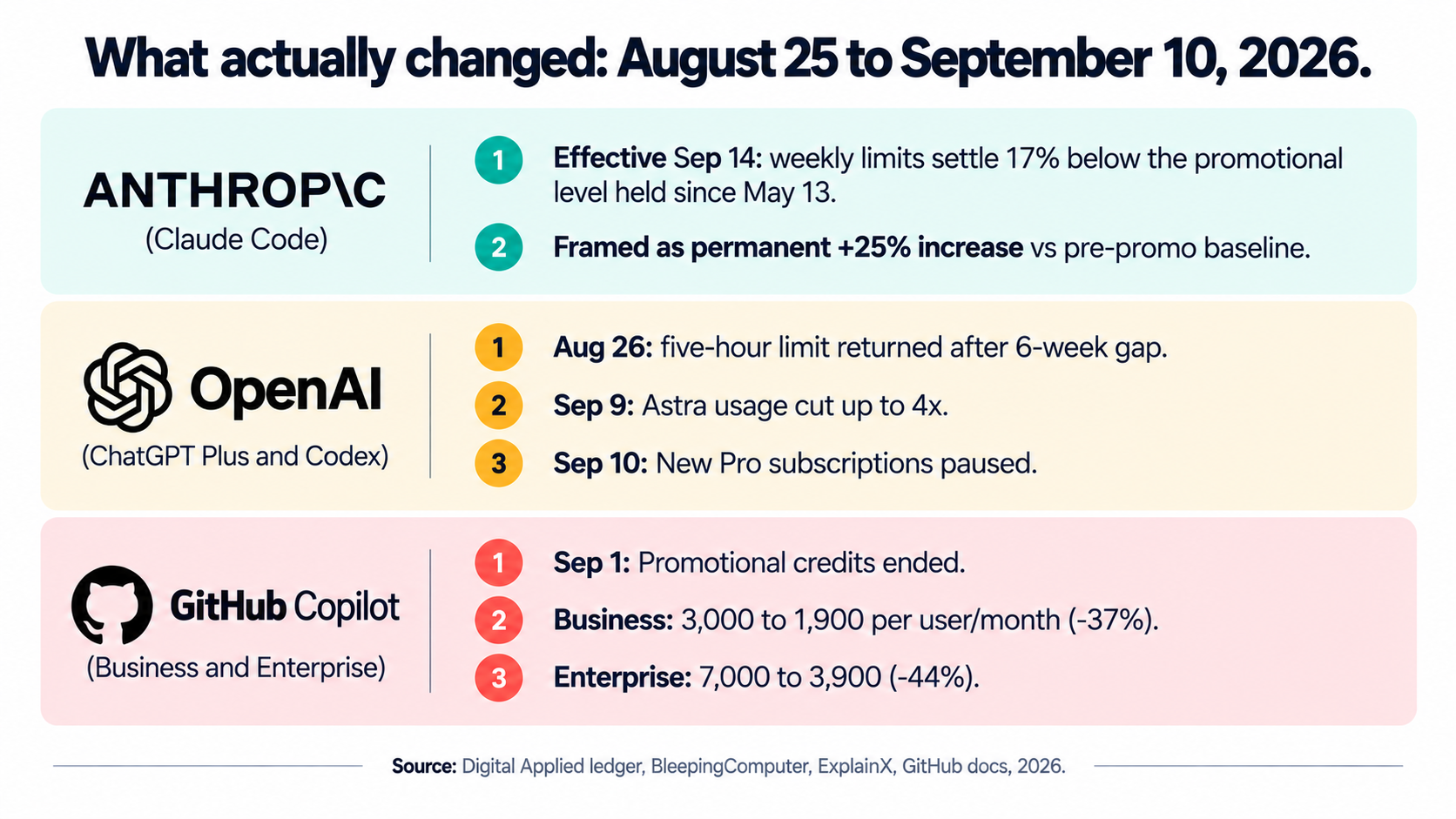 图注:GitHub Copilot Business/Enterprise 促销额度与标准额度对比(英文图表)。
这三周揭示的更广泛模式
Digital Applied 发布了一份详细账本,追踪2026年2月至8月下旬九家厂商付费 AI 编程套餐限额的38项有日期变化。其发现值得了解,因为它们描述的是整个市场,而不仅仅是三个孤立事件。
“按日期顺序阅读这38行,2026年的主导模式不是‘限额上升’或‘限额下降’。而是一次临时增长到期、被反复延长,然后稳定在用户已经习惯的水平之下。” Digital Applied,《AI Coding Plan Limit Change Ledger》,2026年8月29日
在38行中的14行里,厂商的表述与订阅者的实际方向相反。这14行中有13行被表述为增长、改进或中性变化,而订阅者在变化当天经历的是减少。最后一行被表述为增长,却完全没有产生变化,因为厂商自己的帮助中心表示,改进后的套餐在公告日期无法购买。
有两项变化厂商在任何时候都从未宣布。一项是在决定订阅者是否保留旧条款的祖父条款截止日期之后,以文档编辑的形式出现。另一项只有在用户测量到比预期更快的限额消耗速度后才得到确认。如果某个套餐对你的交付计划很重要,关注其文档页面会比更新日志或官方公告更早发出警告。
账本中有四家厂商没有公布至少一个付费层级限额的绝对数字:Anthropic、Cursor、Google 和 Windsurf 都描述了付费套餐的上限,却没有给出数字。它们的订阅者无法从任何厂商发布的来源验证自己的额度。他们可以测量自己的消耗并推断,但无法将定价页面所说与生产环境中所体验到的进行比较。
多窗口问题
账本中的九家厂商有七家同时执行两个或更多用量窗口,有一家执行三个。对于预算而言,这一点以月度标题数字所掩盖的方式产生影响。
一个首页承诺“每月 X 单位”的套餐,也可能同时执行五小时滚动窗口和每周上限。三者中先填满的那个就会阻止你,无论其他窗口还剩多少。一个在周二下午运行繁重处理任务的团队,可能耗尽五小时窗口,而每周额度的80%仍未使用。任务停止,每周预算帮不上忙。
Anthropic(Claude Code): 一个滚动五小时窗口加一个每周上限。两者都没有公布绝对数字。 OpenAI(Codex 和 ChatGPT Work): 一个滚动五小时窗口加一个每周上限,同时从多个界面的共享额度池中抽取。 GitHub Copilot(Business/Enterprise): 按自然月重置且不结转,外加特定模型乘数,决定每月池消耗的速度。 Google(Antigravity): 每周计算上限下的五小时刷新。任何层级都没有公布绝对数字。 那些按月度标题数字做预算并跳过子限额的团队,是在围绕一个并非其真实约束的数字做计划。真正重要的是,对于团队的实际使用模式,哪个窗口先填满。
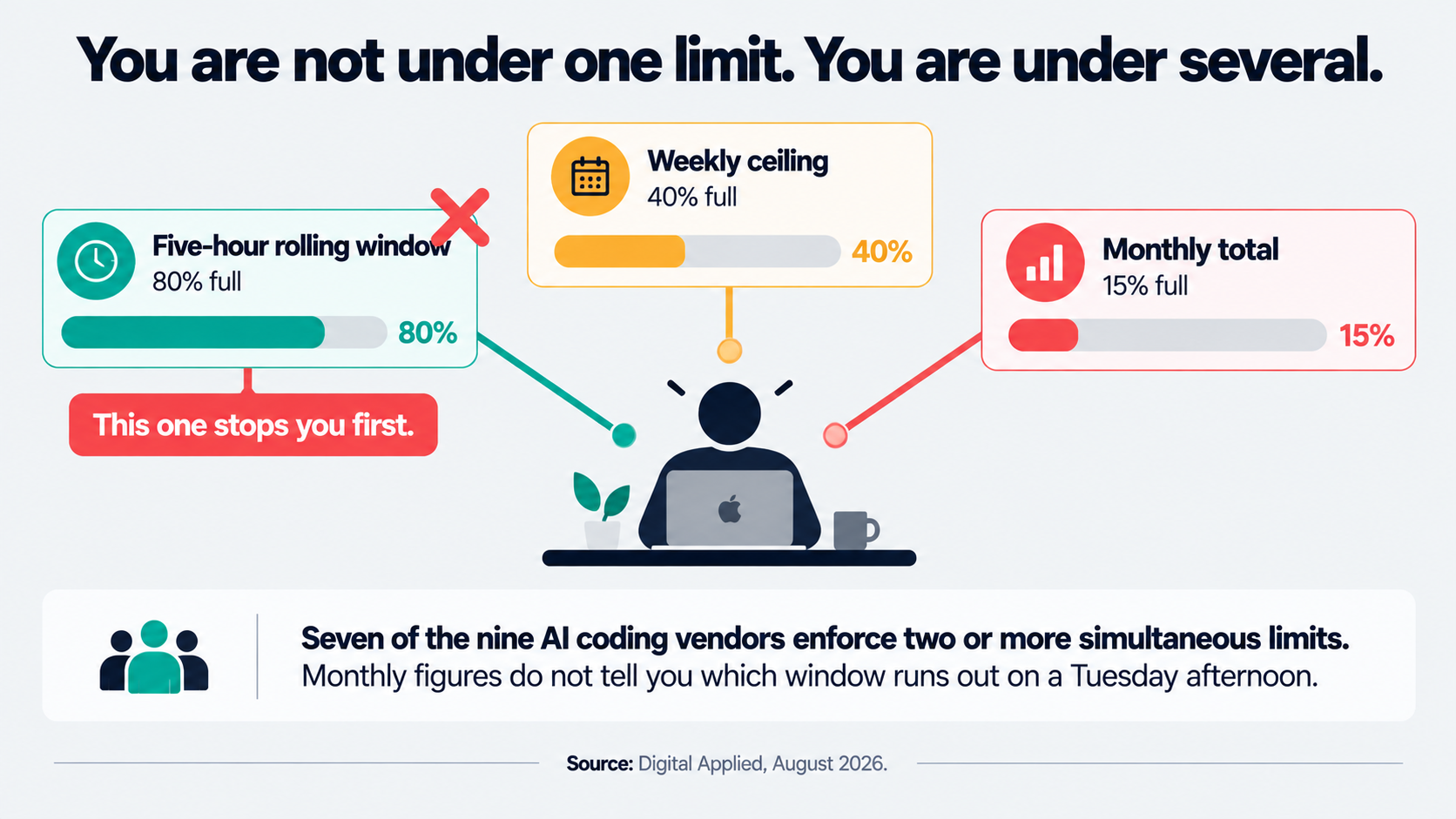 图注:多窗口用量限制(五小时滚动、每周、每月)示意(英文图表)。
如果你为 AI 付费,这意味着什么
2026年9月的局面归结为三件事。促销慷慨正在主要 AI 平台上同时结束。计算成本正通过更紧的配给而非更高的订阅价格来处理。而弄清楚你实际拥有多少可用量的手段往往不透明,无论是有意设计还是疏忽所致。
OpenAI 正在测试的付费重置选项是一个值得仔细解读的信号。它把触发的速率限制从硬性停止变成可购买的覆盖,从而将定价模型改变为一个对厂商可预测、对任何按固定月费做预算的人不可预测的方向。如果这一模式持续,固定订阅购买的是基线访问,高峰时段或高用量使用在其之上计量,AI 密集型工作流的有效成本会随使用强度上升,而不是保持恒定。这与大多数团队在2025年选择 AI 套餐时所依据的经济模型不同。
“订阅者的参照点是他们数月来一直面对的提升后数字。厂商的参照点是促销开始前的基线。双方都可以诚实地描述同一举措,却得出相反的形容词。” Digital Applied,《AI Coding Plan Limit Change Ledger》,2026年8月29日
以下是针对正在发生的变化的四种实际应对:
- 记录你的基线,而不是促销。 如果你的套餐一直在实行临时增长,写下其声明的结束日期和它将稳定至的基线,并据此做预算。在提升后上限下度过的十五周会成为你的心理参照点,无论它是否是承诺的那个。
- 知道哪个窗口先阻止你。 弄清楚你的真实使用更受五小时滚动限额、每周上限还是月度总量的约束。答案因工作流而异:批处理任务更可能触及五小时限额,而分布式团队的合计使用更可能触及每周或每月限额。
- 关注文档,而不是更新日志。 Digital Applied 账本中38项变化有两项从未宣布,且都以文档变化的形式出现。如果某个套餐的上限对你的生产计划很重要,相关文档页面的差异比对会比任何公告渠道更早警告你。
- 不要把已宣布的变化当作已执行的变化。 OpenAI 于7月29日宣布五小时限额回归,而它在8月26日才到达 Plus。两个日期相隔近四周,期间订阅价格从未改变。衡量你的实际限额要对照生产使用,而不是对照最新公告。
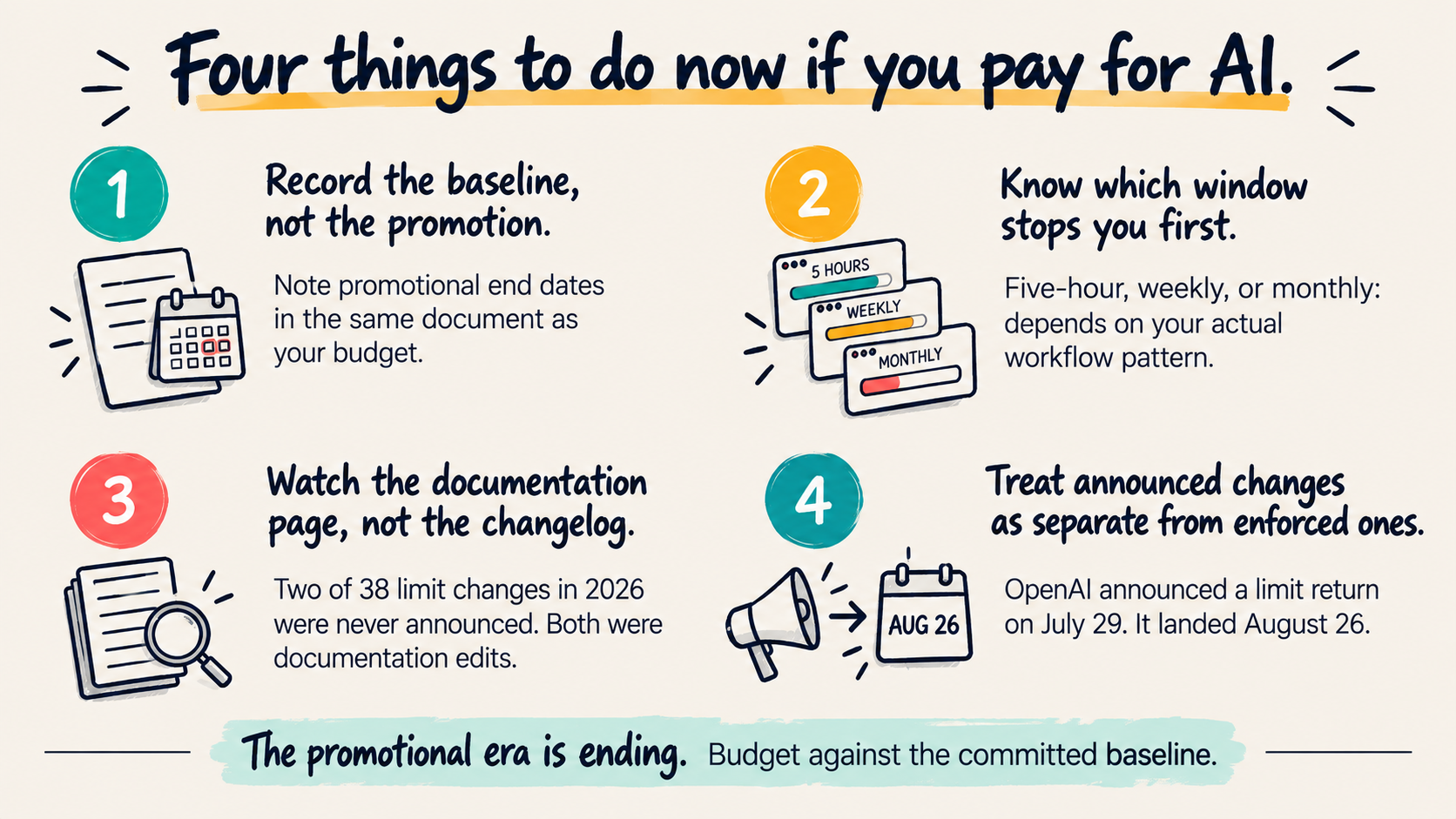 图注:付费 AI 套餐限额跟踪与预算应对示意(英文图表)。
这一切之下的结构性转变
AI 订阅的促销时代完成了它的任务。它大规模建立了用户基础,确立了日常使用习惯,并创造了厂商现在试图更精确变现的市场。2026年末主要平台上正在发生的事是自然的下一步:限额收紧,使用强度被计量,经济结构转向更能反映所用模型计算成本的方向。
GPT-6 Astra 对重度用户的限额被削减至四分之一是一个极端案例,但它反映了底层压力。最有能力的前沿模型大规模运行确实昂贵,一旦使用变得足够密集,固定的20至200美元月订阅无法覆盖这一成本。厂商正在处理增长阶段收费与计算经济所需之间的差距,而市场现在已经成熟到可以接受更细粒度的定价。
对订阅者而言,正确的框架既不是“他们在削减我的访问权限”,也不是“他们在涨价”。而是 AI 工具的稳态定价模型正在实时、公开地确立,通过一系列单独看很小、总体上重要的调整。促销基线正在退场。永久基线正在此刻建立。
理解其套餐多窗口结构、追踪文档而非公告、并依据承诺基线而非促销水平做预算的团队,将在下一次调整到来时不会措手不及。那次调整不是“是否”的问题。而是“何时”以及“哪个窗口”的问题。
喜欢这篇阅读?请务必关注我,获取更多让人有所感触的故事。你也可以在 LinkedIn 或 Telegram @kawsarlog 上与我联系,获取更多关于我工作的更新。
我承接自由职业的抓取和数据自动化项目。欢迎通过 https://www.linkedin.com/in/kawsarlog/ 联系我,或发送邮件至 hi@kawsarlog.com
译文由上游机器翻译生成,可能有误;判断请以英文原文为准。
英文原文(来源本站未改写)
Between August 25 and September 10, 2026, Anthropic, OpenAI, and GitHub Copilot each changed the usage limits on their paid AI plans. Not one announcement said "we are cutting your access," and some presented the change as an increase. The math told a different story
When three major AI vendors reshape their usage limits within the same two weeks, it gets much harder to treat any one of them as an isolated decision. A pattern is showing itself.
It isn't a coincidence of timing. After roughly eighteen months of promotional generosity, the AI subscription market is finding its permanent price floor. The promotions kept users engaged while competition was at its fiercest. Now they are expiring, settling, or being recalibrated, because the compute cost of frontier models demands more careful rationing. A subscriber's access either holds or it doesn't, and the way these adjustments are communicated often makes it hard to tell which.
Below is what actually changed at each of the three vendors, why it matters, and what to track if your work depends on AI tools you pay for every month.
What Anthropic changed: a "25% increase" that is a 17% cut
On August 29, 2026, Anthropic announced a permanent 25% increase to standard weekly usage limits for Claude Code, starting September 14. The announcement called it an increase, and that description is technically correct.
The context is what matters. Since May 13, 2026, Claude Code subscribers had been working with a weekly limit 50% above the pre-promotional baseline. That boost was prolonged through five successive extensions, each of which bought a new end date without committing to a permanent level. Subscribers spent fifteen weeks at the higher ceiling. Many teams built workflows around it, and some even staffed against it.
When September 14 arrives, the weekly limit becomes 125% of the original pre-promotional baseline. Measured against that old number, it's +25%. Measured against the level in force since May, it's -17%. Anthropic's own communications confirmed both figures: "we're permanently raising standard weekly limits in Claude Code by 25%" and, in a follow-up, "this works out to a 17% reduction in weekly limits on Claude Code" against the level in force on the day of the announcement.
Both statements are arithmetically exact. The disagreement isn't over the numbers but over which one sits in the denominator. For the vendor, the reference point is the pre-promotion baseline from six months ago. For the subscriber, it's the ceiling they've been hitting for fifteen weeks. The math is the same, and the adjectives are opposite.
The index in practice: Anthropic publishes no absolute figure for any Claude Code weekly limit on any paid tier: not the baseline, not the boosted level, and not the permanent level from September 14. The only verifiable figures are relative: 100 (baseline), 150 (promotion), and 125 (permanent from September 14). If you want to know how many tokens, prompts, or requests your plan really allows, Anthropic's documentation doesn't contain that number.
What OpenAI changed: the 5-hour limit that kept disappearing
OpenAI's two-week window holds two separate changes. They're worth pulling apart, because each one affects a different set of subscribers in a different way.
On August 25, Tibo Sottiaux, the Codex and ChatGPT lead at OpenAI, announced that the rolling five-hour usage limit would return for Plus accounts the next day. His exact wording: "Tomorrow we will bring back the 5h limit for Plus accounts across ChatGPT Work and Codex. I had mentioned this a while ago, but then postponed it." That sentence carries a quiet admission. The limit had first been announced as returning on July 30, then announced again on August 25, and Plus subscribers went without a five-hour cap for the four weeks in between.
The sequence behind it is documented. On July 12, OpenAI temporarily removed the rolling five-hour limit altogether during GPT-5.6 Sol launch week. On July 29, it announced the limit would be back on July 30, but it didn't return for Plus subscribers that day. The August 25 announcement was the second attempt at the same restoration. In total, the limit was gone for more than six weeks. That absence was partly unintentional and partly postponed, and it was communicated across at least three separate posts, none of which said "we postponed this last time."
The second OpenAI event is sharper. On September 9, OpenAI cut GPT-6 Astra usage limits by up to four times for heavy users, and on September 10 it confirmed that new $200 Pro plan subscriptions were being paused to protect service quality for existing subscribers. OpenAI is also testing a pay-to-reset option: $5 to $8 to instantly refill a hit limit on the Plus plan, rising to $50 to $80 on Pro. Since June, OpenAI had offered free banked resets. That same relief now comes with a price tag.
What GitHub Copilot changed: the promotional window closes
Of the three, GitHub Copilot's September 1 change was the most clearly disclosed. When Copilot Business and Enterprise customers moved to usage-based billing on June 1, 2026, they received promotional included credits: 3,000 per user per month for Business and 7,000 for Enterprise. GitHub's own billing documentation gave the promotional window as June 1 to September 1.
On September 1, the promotional credits ended and the standard included credits took over: 1,900 credits per user per month for Business (a 37% reduction from the promotional level), and 3,900 for Enterprise (a 44% reduction). A ten-person Business team that had been working with 30,000 credits a month now has a September floor of 19,000. If that team didn't adjust its workflow volume during the promotional period, it now faces a gap.
GitHub's transparency here deserves explicit credit. The end date sat in the billing documentation from the start, the standard credits were the committed baseline, and the promotional level was always labeled as promotional. The September 1 reduction was disclosed in advance and spelled out in the docs, and GitHub's announcement framing matched the effective direction. Most of the other changes in the same window weren't communicated with that kind of clarity.
The broader pattern these three weeks reveal
Digital Applied has published a detailed ledger that tracks 38 dated changes to paid AI coding plan limits across nine vendors, from February to late August 2026. Its findings are worth knowing because they describe the market as a whole, not just three individual events.
"Read the 38 rows in date order and the dominant 2026 pattern is not 'limits went up' or 'limits went down'.It is a temporary increase that expires, gets extended repeatedly, and then settles below the level users had grown used to." Digital Applied, AI Coding Plan Limit Change Ledger, August 29, 2026 In 14 of the 38 rows, the vendor's framing and the subscriber's effective direction point opposite ways.Thirteen of those 14 were framed as increases, improvements, or neutral changes, while the subscriber on the day of the change experienced a decrease.
The last one was framed as an increase that produced no change at all, because the vendor's own help center said the improved plan couldn't be purchased on the announced date.
Two changes were never announced by the vendor at any point. One arrived as a documentation edit after the grandfathering deadline that decided whether a subscriber kept their old terms. The other was confirmed only after users measured a faster-than-expected rate of limit consumption. If a plan matters to your delivery schedule, watching its documentation page gives earlier warning than the changelog or official announcements.
Four vendors in the ledger publish no absolute figure for at least one paid tier's limit: Anthropic, Cursor, Google, and Windsurf each describe a paid plan's ceiling without stating a number. Their subscribers can't verify their allowance from any vendor-published source. They can measure their consumption and infer, but they can't compare what the pricing page says with what they experience in production.
The multi-window problem
Seven of the nine vendors in the ledger enforce two or more simultaneous usage windows, and one enforces three. For budgeting, that matters in ways a monthly headline figure hides.
A plan whose homepage promises "X units per month" may also enforce a five-hour rolling window and a weekly ceiling. Whichever of the three fills first is the one that stops you, no matter how much remains in the others. A team running a heavy processing job on a Tuesday afternoon can exhaust a five-hour window while 80% of its weekly allowance is still unspent. The job stops, and the weekly budget doesn't help.
Anthropic (Claude Code): A rolling five-hour window plus a weekly ceiling.No absolute figure is published for either. OpenAI (Codex and ChatGPT Work): A rolling five-hour window plus a weekly ceiling, drawn from a shared credit pool across several surfaces at once. GitHub Copilot (Business/Enterprise): A calendar-month reset with no rollover, plus model-specific multipliers that set how fast the monthly pool drains. Google (Antigravity): A five-hour refresh under a weekly compute ceiling.No absolute figure is published at any tier.Teams that budget against the monthly headline number and skip the sub-limits are planning around a figure that isn't their real constraint.
What counts is whichever window fills first for the team's actual usage pattern.
What this means if you pay for AI
The situation in September 2026 comes down to three things. Promotional generosity is ending across the major AI platforms at the same time. Compute costs are being handled through tighter rationing rather than higher subscription prices. And the means of finding out what you actually have available are often opaque, whether by design or by inattention.
The pay-to-reset option OpenAI is testing is a signal worth reading closely. It turns a hit rate limit from a hard stop into a purchasable override, which changes the pricing model in a direction that's predictable for the vendor and unpredictable for anyone who budgeted around a flat monthly fee. If the pattern holds, a flat subscription buys baseline access, peak-hour or high-volume usage is metered on top of it, and the effective cost of an AI-intensive workflow rises with usage intensity instead of staying constant. That's a different economic model from the one most teams priced against when they chose an AI plan in 2025.
"The subscriber's reference point is the boosted number they have been working against for months. The vendor's reference point is the baseline before the promotion started. Both parties can describe the same move honestly and arrive at opposite adjectives." Digital Applied, AI Coding Plan Limit Change Ledger, August 29, 2026
Here are four practical responses to what's changing:
Record your baseline, not the promotion. If your plan has been running a temporary increase, write down its stated end date and the baseline it will settle at, and budget against that number. Fifteen weeks at a boosted ceiling becomes your mental reference point whether or not it's the committed one.
Know which window stops you first. Work out whether your real usage is more constrained by the five-hour rolling limit, the weekly ceiling, or the monthly total.The answer differs by workflow: a batch job is more likely to hit the five-hour limit, while a distributed team's combined usage is more likely to hit the weekly or monthly one. Watch the documentation, not the changelog. Two of the 38 changes in the Digital Applied ledger were never announced, and both surfaced as documentation changes.
If a plan's ceiling matters to your production schedule, a diff of the relevant documentation page warns you earlier than any announcement channel. Do not treat an announced change as an enforced one. OpenAI announced the five-hour limit's return on July 29, and it reached Plus on August 26.Nearly four weeks separated those dates, and the subscription price never changed in between.Measure your actual limits against production usage, not against the latest announcement.
The structural shift underneath all of this
The promotional era of AI subscriptions did its job. It built user bases at scale, established habits of daily use, and created the market that vendors are now trying to monetise more precisely. What's happening across the major platforms in late 2026 is the natural next step: limits tighten, usage intensity gets metered, and the economic structure shifts toward something that better reflects the compute cost of the models being used.
GPT-6 Astra limits being cut four times for heavy users is an extreme case, but it reflects the underlying pressure. The most capable frontier models are genuinely expensive to run at scale, and a flat $20-$200 monthly subscription can't cover that cost once usage becomes intensive enough. Vendors are working through the gap between what they charged during the growth phase and what the compute economics require, in a market now mature enough to accept more granular pricing.
For subscribers, the right frame is neither "they are cutting my access" nor "they are raising their prices." It's that the steady-state pricing model for AI tools is being set in real time and in public, through a series of adjustments that are individually small and collectively significant. The promotional baseline is on its way out. The permanent one is being established right now.
The team that understands its plan's multi-window structure, tracks the documentation rather than the announcements, and budgets against the committed baseline instead of the promotional level is the team that won't be caught off guard when the next adjustment lands. That adjustment isn't a question of if. It's a question of when, and for which window.
Enjoyed this read? Be sure to follow me for more stories that make people feel things. You can also connect with me on LinkedIn or Telegram @kawsarlog for more updates on my work.
I do freelance scraping and data automation projects. Feel free to contact me on https://www.linkedin.com/in/kawsarlog/ or email at hi@kawsarlog.com
这条还缺什么证据?
下面每条都由本条已有字段推出(等级、理由、商业模式、来源次数、是否演示), 本站不生成推测性结论;通用验证方法放在方法论页。
- 可核验的收入或付费证据查官网定价页与付费口径;第三方数据源(如 GetLatka)只作旁证,需标注来源与时点。
- 商业模式未定确认按席位/按用量/授权还是开源托管版收费;开源项目另查 LICENSE 与是否存在付费版。
- 只有单一来源找一手站点或其他渠道是否重复出现同一产品;社区热帖数量不等于商业进展。
通用验证清单(谁有这个问题/谁愿意付费/一个人能交付哪一小步)见我们的筛选方法。