我们发现了什么
面向AI智能体(Codex、Claude Code)的证据优先家谱研究技能:涵盖前苏联各地的教会书籍、民事、军事、流放和镇压记录。
- 来源:GitHub(发现于 2026-10-27)
- 证据等级:D · 发现产品或需求信号,暂未获得可核验的商业证据。
- 商业模式:待核验
- 主题:独立产品
- 初筛评分:16.8/100 · 收录 1 次
证据,比故事更重要。
规则清洗与初筛,未经人工商业核验。原文语境、实际客户和付费情况仍需自行验证。
引用与数字披露
来源类型(原作者自述/第三方测算/媒体转引)需采集端标注,本版尚未落字段。
- 作者
- 未标注
- 抓取日期
- 来源类型
- 未标注
- 币种
- 未标注
- 口径
- 未标注
- 披露主体
- 未标注
- 披露日期
- 未标注
中文辅助译文(全文)
前苏联亲属关系研究
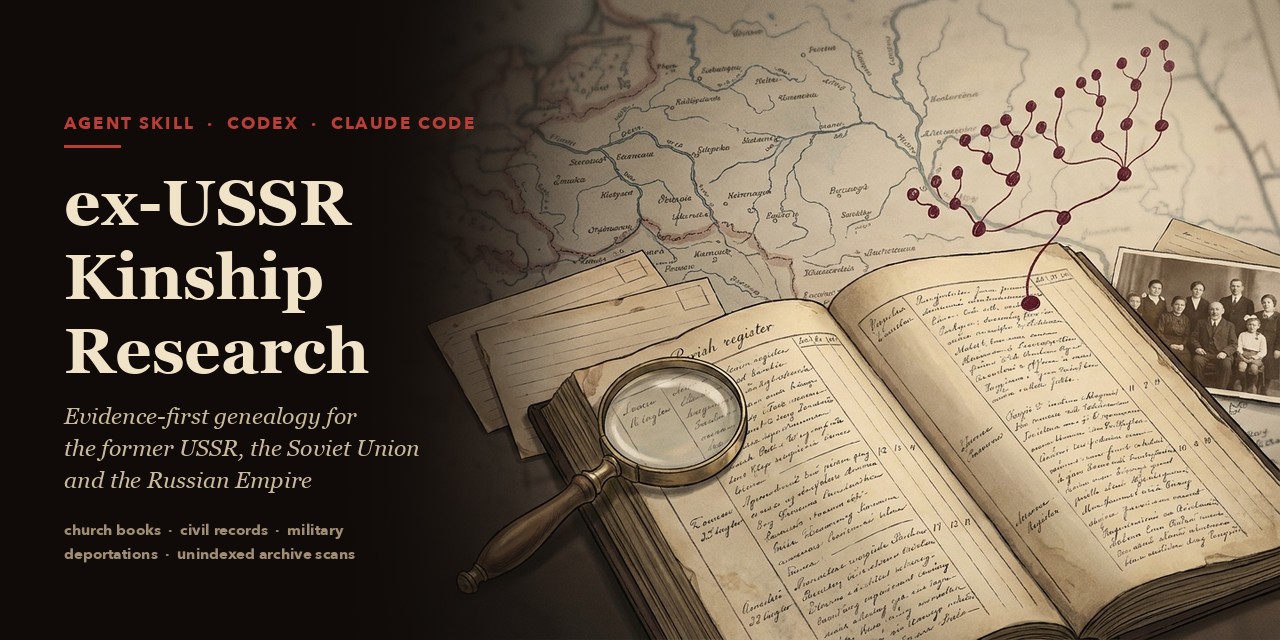
图注:面向 AI 智能体的循证家谱研究技能,可研究前苏联、苏联及俄罗斯帝国时期的家族历史。
一款以证据为先、面向 AI 智能体的家谱研究技能(适用于 Codex、Claude Code 及其他 Agent Skills 运行时)。 它将智能体变成一名严谨的前苏联、苏联和俄罗斯帝国家族史研究者。智能体会查阅教会簿册和民事登记、军事、流放与镇压档案,以及尚未编入索引的档案扫描件。它确保每项发现均可追溯,将原始记录与解读相互分离,并明确说明哪些内容已经证实、哪些尚未证实。
研究范围涵盖前苏联全部 15 个加盟共和国:俄罗斯、乌克兰、白俄罗斯、摩尔多瓦、爱沙尼亚、拉脱维亚、立陶宛、格鲁吉亚、亚美尼亚、阿塞拜疆、哈萨克斯坦、吉尔吉斯斯坦、塔吉克斯坦、土库曼斯坦和乌兹别克斯坦。档案应根据事件发生时的历史管辖区和当前的记录保管机构来选择;地区性示例不能替代当地研究。
该技能的说明以俄语编写,但智能体会使用你的语言与你交流:英语、乌克兰语、俄语、波兰语、德语等。它会以原文拼写引用来源并附上翻译,还会使用记录所使用的语言构建搜索查询。
功能
- 案件接收与范围界定。 明确一个研究问题、已知事实、可能仍在世的人员以及不可触碰的事项。- 可复现的登记册。 记录人员、实物、主张、亲属关系和完整的搜索日志(CSV),并提供最终报告模板。- 历史管辖权模型。 将每项事件对应到事件发生之时的国家、省、区、教区或民事登记机构,而非今天的地图。- 姓名变体矩阵。 收录改革前的俄语、乌克兰语、波兰语、罗马尼亚语、德语和意第绪语形式,以及父称、婚前姓名和音译形式。- 来源策略。 优先使用原始资料,其次是官方目录、索引和已出版文献集,只有在前述来源均不可用时,才将家谱树和论坛作为线索。- 证据协议。 各项主张会获得可解释的状态,而非百分比:
hypothesis(假设)、single-source(单一来源)、corroborated(已佐证)、strongly-corroborated(强力佐证)、contradicted(存在矛盾)、unresolved(未解决)。同一记录的不同副本和镜像共享一个independence_group,因此绝不会被计为相互独立的证据。- 身份解析。 在出现区分性证据之前,同名者会保留为不同的person_id:门牌号、父母、教父母、准确出生日期或军队单位。- 审计脚本。 在你撰写结论之前,它会检查引用完整性并标记薄弱的佐证。只有当被引用的实物属于某个独立组时,该独立组才会计入,因此不能凭空宣布存在佐证。它还会检查最终报告:每个被引用的 ID 都必须存在于登记册中,每个状态都必须与其一致。
摘要会显示仍未获得佐证或被标记为无法辨认的内容。- 机构请求。 起草并在获得授权后发送有针对性的请求,可使用现有的电子邮件或官方网页工具发送至档案馆、图书馆、大学和博物馆。必要时,可提供受支持的邮件集成方案或可直接发送的信函。记录发送结果,避免重复发送,并将回复视为证据。参见通信指南。- 最终报告。 逐条列出每一项亲属关系,并说明矛盾、未成功的搜索以及具体的下一步行动。- 有针对性的索引记录研究。 通过现有的合法浏览器会话,按地点或 DGS 查找相关 FamilySearch 书籍,查看具体记录,并且只保留来源允许保存的证据片段。本地辅助工具会在保存的片段中搜索亲属、见证人和姓名变体,同时保留其上下文和文件校验和。工作流程与覆盖范围限制。- 一战来源搜索。 按人员或地点搜索 GWAR 报告、医院记录和授奖记录,然后定位来源图像。工作流程。这两项辅助工具都会将结果导入现有的实物登记册和搜索日志,但不会自动确立身份或亲属关系。
发布历史:变更日志。
安装
将仓库克隆到智能体的技能文件夹:
# Codex
git clone https://github.com/DenisSergeevitch/ex-ussr-kinship-research ~/.codex/skills/ex-ussr-kinship-research

# Claude Code(个人技能)
git clone https://github.com/DenisSergeevitch/ex-ussr-kinship-research ~/.claude/skills/ex-ussr-kinship-research
对于单个项目,请将文件夹放在仓库内的 .claude/skills/ 中。这些脚本只需要 Python 3 和标准库;build_pdf.py 还需要基于 Chromium 的浏览器。
使用
描述家族问题。智能体会利用现有信息开展研究,并在问题或访问请求等待回复期间继续工作。例如:
- “我的曾祖父在 1930 年代被流放到哈萨克斯坦。请帮我在教会记录中查找他的父母。”
- “这些是结婚证和士兵卡的扫描件。请检查它们是否属于同一个人,并建立证据链。”
- “请查找 1890 年代波多利亞某个村庄所属的教区及正确的 FamilySearch 胶卷,并阅读姓氏 X 的出生记录。”
请将私人案件数据保存在该技能的 Git 检出目录之外。在技能文件夹中运行:
python scripts/init_case.py --case-dir ~/kinship-cases/my-case --research-question "Who were Maria's parents?" --subject-label "Maria"
python scripts/hash_artifact.py ~/kinship-cases/my-case/scans/marriage-1902.jpg # SHA-256 for every saved artifact
python scripts/audit_evidence.py --case-dir ~/kinship-cases/my-case # check registers before the final report
python scripts/build_pdf.py --html ~/kinship-cases/my-case/pdf-source/report.html --out ~/kinship-cases/my-case/report.pdf
init_case.py 拒绝在技能文件夹内创建案件,即使使用 --force 也不例外。作为额外保护措施,Git 会忽略常见的旧版案件文件夹名称;贡献代码前请检查暂存区文件,尤其是在移动现有案件时。
build_pdf.py 要求安装 Chrome、Chromium 或 Edge(或者设置 CHROME_PATH)。使用 --png-dir 时,如果 pypdfium2 可用,它还会将页面渲染为 PNG 以供审阅。
请使用包含本地或内嵌图像的静态 HTML。活动的 HTML 和网络图像来源会被拒绝;来源链接仍可点击。渲染失败时,现有的输出 PDF 会保留。
仓库结构
SKILL.md 主要说明(工作流程、硬性规则、语言政策)
references/
source-strategy.md 来源层级、查询模式、目录、档案请求
correspondence.md 收件人、邮件集成、授权发送和回复
evidence-protocol.md 实物评估、状态、身份解析、冲突
ex-ussr-locale-guide.md 司法辖区、姓名变体、历法、各时期的记录类型
browser-and-captcha.md 浏览、登录、一次验证码尝试及人工接管、速率限制
privacy-and-safety.md 在世人员、未成年人、DNA、敏感发现
seed-sources.md 按可靠性等级分类的精选起始资源
field-lessons.md 来自真实案件实践经验
changelog.md 发布历史
photo-search.md 查找、识别、确定日期并存储照片
habsburg-galicia-bukovina.md 哈布斯堡统治时期及其后的加利西亚和布科维纳
familysearch-indexes.md 有针对性的浏览器研究、允许保存的本地快照和覆盖范围
ww1-search.md GWAR 一战人员/地点搜索及来源图像定位器
assets/ 案件接收、CSV 登记册、最终报告模板、
照片 README 模板、可读 PDF 模板(report-pdf.template.html)
scripts/ init_case.py、hash_artifact.py、audit_evidence.py、build_pdf.py
familysearch.py、gwar.py、register_search.py 和共享本地分析模块
evals/discovery-and-logic.yaml 触发和推理测试用例
tests/ 单元测试(python3 -m unittest discover -s tests)
负责任的使用
- 用于家族历史,而非监控。 该技能拒绝查找在世人员的现住址、电话号码或账户,并尽量减少报告中包含的个人数据。
- 访问检查。 在支持且允许的情况下,智能体可以通过其内部浏览器的常规控件尝试一次真实的验证码。如果需要用户操作,它会在可能的情况下打开相应标签页,并提供 URL 和所需操作;登录由用户完成。不得使用外部验证码求解服务、防护绕过手段,或规避付费墙、地理限制和速率限制,也不得使用泄露的数据库。参见浏览器指南。
- 未经你的明确同意,不得将你的文档或 DNA 数据上传到第三方服务。
- 敏感发现(流放、镇压、收养、DNA 意外结果)应以中立方式报告,且仅限于回答问题所需的程度。
- 授权通信。 当用户已授权时,该技能可以通过现有工具发送机构请求;对于已经获准的发送,它不会再次询问。仅连接邮箱并不代表授权发送、添加附件或使用付费服务。请核实当前的官方联系方式和流程,并将凭据和私人案件通信保存在技能仓库之外。
贡献
欢迎在 references/seed-sources.md 中添加新来源。在已知的情况下,记录经过核实的所有者、司法辖区、馆藏、来源出处、ID、访问方式、限制和核查日期;应标记信息缺口,而不是猜测。请勿在示例中包含个人数据。
来源搜索辅助工具使用 Python 标准库和现有案件登记册。运行 python3 -m unittest discover -s tests,使用合成数据检查本地解析、GWAR 检查点、访问失败、未解决的覆盖范围和证据登记情况。FamilySearch 的发现和有针对性的查看功能使用现有的合法浏览器会话;其 Python 辅助工具会分析保存的片段。请将私人研究文件保存在此检出目录之外。
许可证
MIT © 2026 Denis Shiryaev。
由 Denis Shiryaev 维护(@DenisSergeevitch)。
译文由上游机器翻译生成,可能有误;判断请以英文原文为准。
英文原文(来源本站未改写)
ex-USSR Kinship Research
An evidence-first genealogy skill for AI agents (Codex, Claude Code and other Agent Skills runtimes). It turns an agent into a careful family-history researcher for the former USSR, the Soviet Union and the Russian Empire. The agent reads church books and civil records, military, deportation and repression files, and unindexed archive scans. It keeps every find traceable, separates records from interpretation and says plainly what is proven and what is not.
Coverage includes all 15 former Soviet republics: Russia, Ukraine, Belarus, Moldova, Estonia, Latvia, Lithuania, Georgia, Armenia, Azerbaijan, Kazakhstan, Kyrgyzstan, Tajikistan, Turkmenistan and Uzbekistan. Archives are chosen by the event's historical jurisdiction and current record custodian; a regional example does not replace local research.
The skill's instructions are written in Russian, but the agent talks to you in your language: English, Ukrainian, Russian, Polish, German and so on. It quotes sources in their original spelling with a translation, and builds search queries in the languages of the records.
What it does
- Case intake and scope. One research question, known facts, who may be alive, what is off-limits.
- Reproducible registers. Persons, artifacts, claims, relationships and a full search log (CSV), plus a final report template.
- Historical jurisdiction model. It resolves every event to the state, province, district, parish or civil registry as of the event date, not today's map.
- Name-variant matrices. Pre-reform Russian, Ukrainian, Polish, Romanian, German and Yiddish forms, patronymics, maiden names and transliterations.
- Source strategy. Originals first, then official catalogs, indexes, published document collections, and only then trees and forums as leads.
- Evidence protocol. Claims get explainable statuses, not percentages:
hypothesis,single-source,corroborated,strongly-corroborated,contradicted,unresolved.
Copies and mirrors of one record share an independence_group, so they never count as independent proof.
- Identity resolution. Namesakes stay separate person_ids until distinguishing evidence appears: house number, parents, godparents, exact birth date or military unit.
- Audit script. It checks referential integrity and flags weak corroboration before you write conclusions.An independence group counts only when a cited artifact belongs to it, so corroboration cannot be declared into existence.It also checks the final report: every cited ID must exist in the registers and every status must match them.
A summary shows what is still uncorroborated or marked illegible. - Institutional requests. Draft and, when authorized, send focused requests to archives, libraries, universities and museums using available email or official web tools.If needed, offer a supported mail integration or a ready-to-send letter.Record the outcome, avoid duplicate sends and treat replies as evidence.
See correspondence guidance. - Final report. Every relationship is laid out edge by edge, with contradictions, failed searches and concrete next steps. - Targeted indexed-record research. Find relevant FamilySearch books by place or DGS through an existing lawful browser session, view specific records, and retain only evidence fragments permitted by the source.
Local helpers search relatives, witnesses and name variants in saved fragments, preserving their context and file checksums. Workflow and coverage limits. - WWI source search. Search GWAR reports, hospital and award records by person or locality, then locate the source image. Workflow.Both helpers feed the existing artifact register and search log;they do not establish identities or kinship automatically.
Release history: changelog.
Install
Clone the repository into your agent's skills folder:
# Codex
git clone https://github.com/DenisSergeevitch/ex-ussr-kinship-research ~/.codex/skills/ex-ussr-kinship-research

# Claude Code (personal skills)
git clone https://github.com/DenisSergeevitch/ex-ussr-kinship-research ~/.claude/skills/ex-ussr-kinship-research
For a single project, put the folder in .claude/skills/ inside the repository. The scripts need only Python 3 and the standard library; build_pdf.py also needs a Chromium-based browser.
Use
Describe the family question. The agent works from available information and continues while questions or access requests await a reply. For example:
- "My great-grandfather was exiled to Kazakhstan in the 1930s. Help me find his parents in church records."
- "Here are scans of a marriage certificate and a soldier card. Check whether they are the same person and build the evidence chain."
- "Find the parish and the right FamilySearch film for a village in Podolia in the 1890s and read the births for the surname X."
Keep private case data outside the skill's Git checkout. From the skill folder:
python scripts/init_case.py --case-dir ~/kinship-cases/my-case --research-question "Who were Maria's parents?" --subject-label "Maria"
python scripts/hash_artifact.py ~/kinship-cases/my-case/scans/marriage-1902.jpg   # SHA-256 for every saved artifact
python scripts/audit_evidence.py --case-dir ~/kinship-cases/my-case             # check registers before the final report
python scripts/build_pdf.py --html ~/kinship-cases/my-case/pdf-source/report.html --out ~/kinship-cases/my-case/report.pdf
init_case.py refuses to create a case inside the skill folder, including with
--force. Git ignores common legacy case-folder names as an additional safeguard;
check staged files before contributing, especially if moving an existing case.
build_pdf.py needs Chrome, Chromium or Edge installed (or CHROME_PATH). With --png-dir it also renders pages to PNG for review if pypdfium2 is available.
Use static HTML with local or embedded images. Active HTML and network image sources are rejected; source links remain clickable. A failed render preserves any existing output PDF.
Repository layout
SKILL.md                         main instructions (workflow, hard rules, language policy)
references/
  source-strategy.md             source hierarchy, query patterns, catalogs, archive requests
  correspondence.md              recipients, mail integration, authorized sending and replies
  evidence-protocol.md           artifact assessment, statuses, identity resolution, conflicts
  ex-ussr-locale-guide.md        jurisdictions, name variants, calendars, record types by period
  browser-and-captcha.md         browsing, sign-in, one CAPTCHA attempt and hand-off, rate limits
  privacy-and-safety.md          living people, minors, DNA, sensitive findings
  seed-sources.md                curated starting resources with reliability classes
  field-lessons.md               practical lessons from a real case
  changelog.md                   release history
  photo-search.md                finding, identifying, dating and storing photos
  habsburg-galicia-bukovina.md   Galicia and Bukovina under the Habsburgs and after
  familysearch-indexes.md       targeted browser research, permitted local snapshots and coverage
  ww1-search.md                 GWAR WWI person/locality search and source-image locators
assets/                          case intake, CSV registers, final report template,
                                 photos README template, readable PDF template (report-pdf.template.html)
scripts/                         init_case.py, hash_artifact.py, audit_evidence.py, build_pdf.py
                                 familysearch.py, gwar.py, register_search.py and shared local analysis modules
evals/discovery-and-logic.yaml   trigger and reasoning test cases
tests/                           unit tests (python3 -m unittest discover -s tests)
Responsible use
- Family history, not surveillance. The skill refuses to look up current addresses, phones or accounts of living people, and it minimizes their data in reports.
- Access checks. The agent may try an actual CAPTCHA once through normal controls in its internal browser when supported and allowed.If user action is needed, it opens the relevant tab when possible and provides the URL and required action;sign-ins are done by the user.No external solvers, protection bypass, paywall, geo-block or rate-limit evasion, or leaked databases.
See browser guidance. - No uploads of your documents or DNA data to third-party services without your explicit consent. - Sensitive findings (deportation, repression, adoption, DNA surprises) are reported neutrally and only as far as the question requires. - Authorized correspondence. The skill can send institutional requests through available tools when the user has authorized them;it does not ask again for an already authorized send.Connecting a mailbox alone does not authorize sending, attachments or paid services.
Verify the current official contact and procedure, and keep credentials and private case correspondence outside the skill repository.
Contributing
New sources are welcome in references/seed-sources.md. Record verified owner, jurisdiction, collection, provenance, IDs, access, restrictions and check date where known; mark gaps instead of guessing. Keep personal data out of examples.
Source-search helpers use Python's standard library and the existing case registers. Run python3 -m unittest discover -s tests to check local parsing, GWAR checkpoints, access failures, unresolved coverage and evidence registration against synthetic data. FamilySearch discovery and targeted viewing use the existing lawful browser session; its Python helpers analyze saved fragments. Keep private research files outside this checkout.
License
MIT © 2026 Denis Shiryaev.
Maintained by Denis Shiryaev (@DenisSergeevitch).
出处https://github.com/DenisSergeevitch/ex-ussr-kinship-research
这条还缺什么证据?
下面每条都由本条已有字段推出(等级、理由、商业模式、来源次数、是否演示), 本站不生成推测性结论;通用验证方法放在方法论页。
- 可核验的收入或付费证据查官网定价页与付费口径;第三方数据源(如 GetLatka)只作旁证,需标注来源与时点。
- 商业模式未定确认按席位/按用量/授权还是开源托管版收费;开源项目另查 LICENSE 与是否存在付费版。
- 只有单一来源找一手站点或其他渠道是否重复出现同一产品;社区热帖数量不等于商业进展。
通用验证清单(谁有这个问题/谁愿意付费/一个人能交付哪一小步)见我们的筛选方法。